
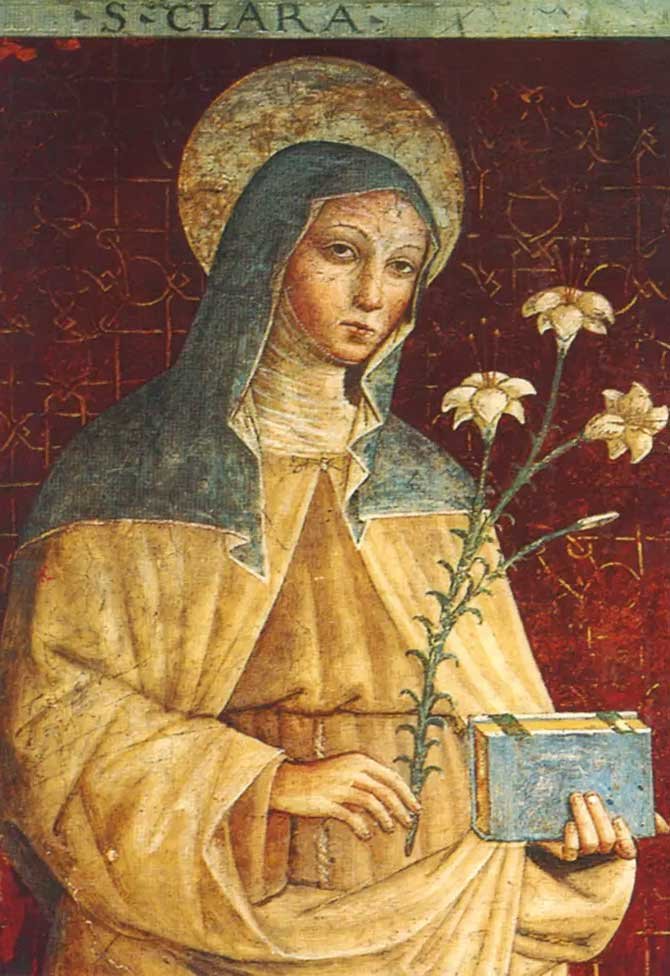
St. Clare of Assisi
Clare was born in 1194 in a noble and rich family, the daughter of Favarone d’Offreduccio and Lady Ortolana, a very pious and courageous woman who had made long and dangerous pilgrimages, including to the Holy Land. Clare was her first child and during her pregnancy Ortolana went to the church to pray for a safe delivery; she heard the lord telling her: “do not be afraid, you will safely give birth to a light who will illumine the whole world.” So, when the little girl was born her mother called her Chiara; “Clare”, “the shining one.” She was brought up in a religious way, and already as a child felt drawn by the love of Jesus to give her life to Him. She loved prayer, counting the “Our Father” she was reciting with a heap of little pebbles. (the rosary did not exist yet at that time) She was very kind towards the poor, sometimes depriving herself of nice food for them. When she was about 17, her relatives wanted to arrange a rich and noble marriage for her which would bring honour to the whole family, but she refused, wanting to consecrate herself to the lord.
For some years already, Brother Francis, the little beggar of God, and his first followers were preaching repentance and the message of the Gospel in the region. In 1210 Francis preached during the whole Lenten season in the cathedral of Assisi. Clare felt that he was the messenger of God for her and she arranged with a trusted friend to have private meetings with him. Francis encouraged her in her resolution and she decided to leave the world and follow Jesus in the way Francis was showing her.
On Palm Sunday night 1211 or 1212 (the historians are not sure) she left her wealthy home and ran to the small Chapel of St Mary of the Angels where the Friars were waiting for her, and she took her vows in the hands of Francis. He led her first to a monastery of Benedictine Nuns, St Paulo. Her uncles and relatives tried by force to take her back, but she resisted and removing her veil, showed them her shorn head- sign of religious consecration: they could not touch her- so they were obliged to leave her alone. She went to another monastery where her sister Catherine joined her two weeks later, which added to the fury of the family, Finally Francis led them to the little monastery of San Damiano, the church he had rebuilt at the beginning of his conversion. In a short time, many young ladies joined Clare in her life of prayer, simplicity, poverty and sisterly love.
She struggled all her life for her religious family to be recognized by the Church as part of the Order of St Francis and to have the right to live without any possession. (The successive Popes wanted either to impose on her the Benedictine Rule or the Rule they were writing for her) Finally, she wrote her own Form of Life, largely inspired by the Rule of St Francis, and it was approved by Pope Innocent IV two days before her death which occurred 0n 11 August 2053. By then, there were more than 100 Monasteries of Poor Sisters throughout Italy and in different countries of Europe.
We have the good fortune to still possess the Acts of the Process of Canonization of St Clare which was conducted in San Damiano three months after her death and in which 14 of her sisters and 5 lay people who had known her well witnessed to her holiness, giving many details of her way of life. They mentioned her intense life of prayer and harsh penance, especially during her young years, before she fell ill; they speak of the numerous miracles she did for the sick, especially children who were brought to her. The power of her prayer, together with her sisters, saved the monastery from the attack of soldiers who had already entered the enclosure; Clare had brought the Blessed Sacrament near the door and begged the Lord to protect the community. A voice was heard saying “I will always guard you”. Another time, the town of Assisi who was under siege was also liberated by their intercession: the army of the enemy left during the night without causing any harm.
But the witnesses insisted above all about the great charity of Clare, her spirit of poverty, simplicity and humility that made of her a real mother, in the humblest service of her sisters.
All her life was a following of Jesus whom she contemplated with love, as she advised her great friend, St Agnes of Prague: “Gaze upon Him, consider Him, contemplate him as you desire to imitate Him.” She did this so well that some witnesses of the Process of Canonization called her “the Mirror of the Blessed Virgin Mary”. She was canonised two years after her death on 15th August 1255 by Pope Alexander IV.
Therefore, beloved sisters, we must consider the immense gifts that God has bestowed on us, especially those that He has seen fit to work in us through His beloved servant, our blessed father Francis.
St. Clare (Test No. 2)